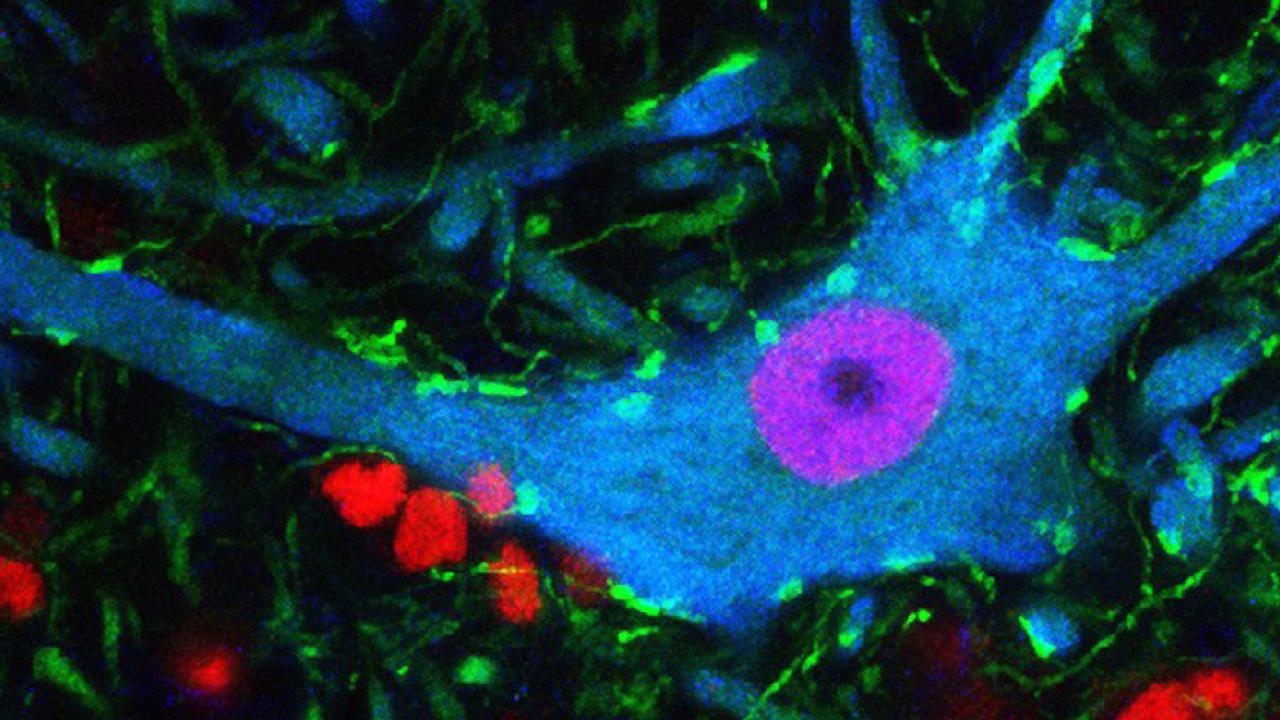
Cell-cell interactions during circuit development in the visual system and cerebellum A major focus of our lab is to determine how axons grow and navigate through pathways in the developing brain, using the visual system as a model. We study how growth cones of retinal ganglion cell axons cross or avoid the midline of the optic chiasm, a projection pattern important for binocular vision. We have chronicled growth cone behavior in the context of the brain by dynamic imaging, and correlated light and electron microscopy. More recently we have identified a molecular program, including transcription factors and guidance receptorsthat regulates cell identity and projection of the ipsilateral retinal axon pathway through the optic chiasm. New work aims to understand transcriptional regulation of guidance receptor expression, the synthesis and fate of guidance receptors during growth cone interactions with specialized glia at the chiasm midline, and how the projections from the two eyes establish segregated connections in thalamic targets. A companion research interest is the analysis of axon-target interactions during formation of the circuitry of the cerebellum, essential to the motor system circuit. As in studies of the visual system, we use static and dynamic analyses of growth cone and dendrite behavior, and have developed methods for purifying different classes of neuron for in vitro analyses. We have explored cellular and molecular mechanisms of discrete steps in afferent mossy fiber growth and synapse formation with granule neuron targets, and in the interactions between granule neuron axons and Purkinje cells that lead to dendrite and spine differentiation.
Carol Mason is a Professor of Pathology, and Anatomy and Cell Biology, and is a member of the Center for Neurobiology and Behavior. She received her Ph.D. in Zoology at the University of California, Berkeley, with a focus on invertebrate neurobiology. In postdoctoral work at the Universities of Bristol, Wisconsin and Chicago, she studied the cellular neuroanatomy of the vertebrate neuroendocrine and the developing visual systems. In 1980, she joined the faculty of the Department of Pharmacology at New York University School of Medicine. In 1987, she became Associate Professor and in 1992, Professor in the Department of Pathology at Columbia University, College of Physicians and Surgeons.
| 1973 |
Ph.D., University of California, Berkeley |
| 1973-76 |
Nuffield Foundation Postdoctoral Fellow, University of Bristol |
| 1976-77 |
Postdoctoral Scientist, University of Wisconsin |
| 1977-80 |
Postdoctoral Scientist, University of Chicago |
| 1966 |
Phi Beta Kappa |
| 1967 |
Woodrow Wilson Fellowship |
| 1983-87 |
Irma Hirschl Career Scientist Award |
| 1982-86 |
NIH Research Career Development Award |
| 1992-99 |
Jacob Javits Neuroscience Investigator Award |
| 1997-2001 |
Member, NIH/NEI Visual Sciences B Study Section |
| 2000-2003 |
Reviewing Editor, The Journal of Neuroscience |
| 2001- |
PI, National Eye Institute Vision Sciences Training Program at Columbia University |
| 2004- |
Councilor, Society for Neuroscience |
- Herrera, E., Brown, L, Aruga, J., Rachel, R.A., Dolen, G., Mikoshiba, K., Brown, S. and Mason, C.A. (2003) Zic2 patterns binocular vision by specifying the uncrossed retinal projection. Cell 114: 545-557.
- Williams, S.E., Mann, F., Sakurai, T., Erskine, L.,Wei, A., Rossi, D.J., Gale, N., Holt, C.E., Mason, C.A., and Henkemeyer, M. (2003) Ephrin-B2 and EphB1 mediate retinal axon divergence at the optic chiasm. Neuron 39: 919-935.
- Williams, S.E., Mason, C.A., and Herrera, E. (2004) The optic chiasm as a midline choice point. Curr. Op. Neurobiol. 14: 51-60
- Herrera, E., Marcus, R., Li, S., Williams, S.E., Erskine, L., Lai, E., and Mason, C. (2004) Foxd1 is required for normal development of the optic chiasm. Development 131: 5727-39.
- Dunaevsky, A. and Mason, C.A. 2003 Spine motility with synaptic contact: A means toward an end? Trends Neurosci. 26: 155-160.
- Heuer, H. and C.A. Mason (2003) Thyroid hormone induces cerebellar Purkinje cell dendritic development via the thyroid hormone receptor alpha1. J. Neurosci. 19: 10604-10612.
|
 |
|