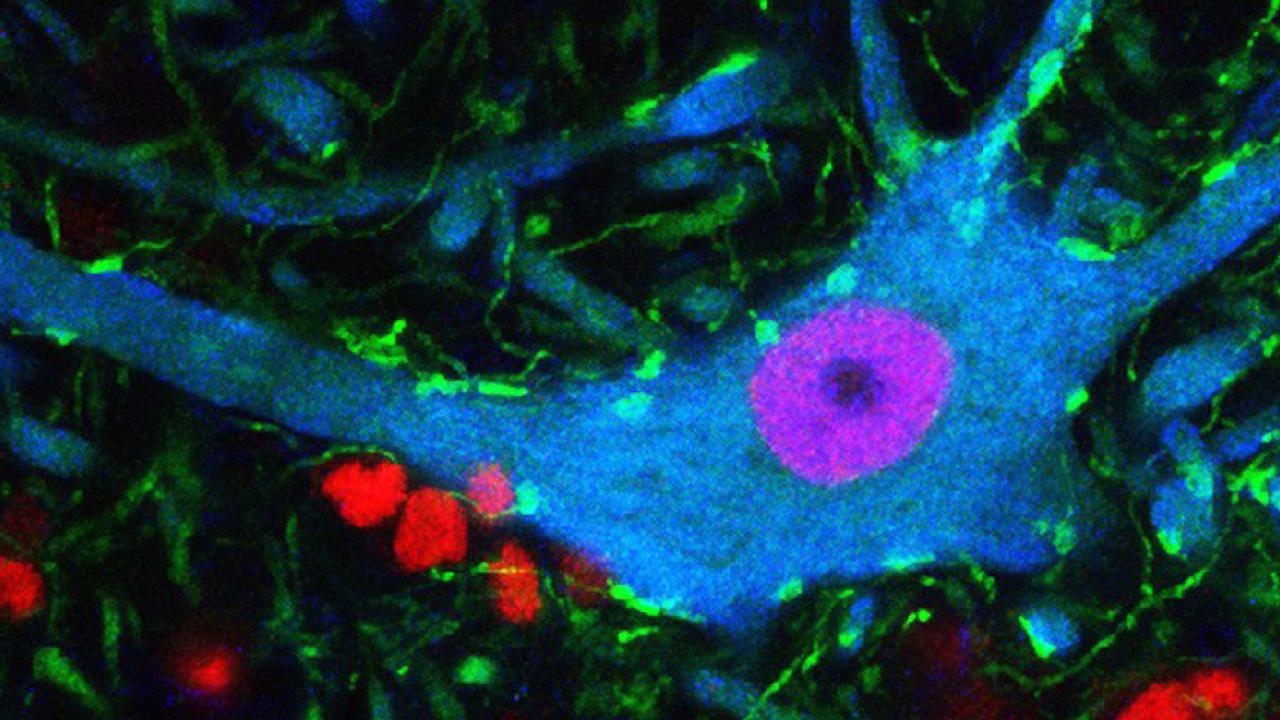
Molecular Mechanisms of Neuronal Death The major focus of our laboratory is the study of the molecular mechanisms of neuronal death. Neuronal loss is an outstanding feature of neurodegenerative diseases, such as Alzheimer's disease, Parkinson's disease and amyotrophic lateral sclerosis. We employ model systems of neuronal death to define the death pathways. We are particularly interested in the regulation of the caspases, the family of proteases that are central to the execution of death. Current death paradigms under study include ?-amyloid toxicity, peroxynitrite-mediated death, neurotrophin-withdrawal-induced death, hypoglycemic death and mouse models of CNS ischemia. We have developed specific molecular tools for knocking down individual members of the death pathways in post-mitotic (neuronal) cells. Mosth recently we have developed a non-toxic method of delivering siRNA (V-siRNA)to neurons with 100% efficiency. We have shown that the specificity of the death pathway is determined by the stimulus inducing death but also that there is flexibility in the pathways chosen for executing death. The dominant pathway depends on the relative concentrations of anti- and pro-apoptotic proteins. This illustrates that the maintenance of life and execution of death of a neuron is a delicate balance of the pro- and anti-apoptotic molecules in the cell, a balance that can be altered in disease. Our studies of oxidative stress-mediated death show that cytokines can induce an autocrine mediated death. Down-regulation of superoxide dismutase 1 leads to activation of caspase-1 which releases the cytokine interleukin-1-? and the cells undergo a peroxynitrite-dependent death. Thus, although caspase-1 has been defined as a non-apoptotic caspase with a role in inflammation, in response to specific death stimuli caspase-1 can activate a death pathway. It is important to understand the interactions that can occur between the cytokine signaling pathway and the death pathway to determine the appropriate intervention that will result in increased neuronal survival.
Carol M. Troy is Associate Professor of Clinical Pathology and Neurology in the Taub Center for the Study of Alzheimer's Disease and the Aging Brain at Columbia University College of Physicians and Surgeons and a member of the faculty of Cell Biology and Pathobiology Graduate Program. She did her undergraduate studies at Brandeis University and received her M.D. and Ph.D. degrees from NYU School of Medicine. After completing a neurology residency at Columbia's Neurologic Institute, she did a postdoctoral fellowship with Michael Shelanski at Columbia and was appointed as an Assistant Professor in the Department of Pathology in 1992.
| 1977 |
A.B. Brandeis University, Waltham, MA Biochemistry |
| 1980 |
M.S. NYU Graduate School of Arts and Sciences, New York, NY Pharmacology |
| 1984 |
Ph.D. NYU Graduate School of Arts and Sciences, New York, NY Pharmacology |
| 1984 |
M.D. NYU School of Medicine, New York, NY |
| 1984-85 |
Internship, Bellevue Hospital, NYU Medical Center, Medicine |
| 1985-88 |
Residency, Columbia University College of Physicians & Surgeons, Neurology |
| 1988-89 |
NINCDS Postdoctoral Fellow in Neuropathology, Columbia University College of Physicians and Surgeons |
| 1989-92 |
Instructor in Pathology, Columbia University College of Physicians and Surgeons |
| 1977 |
A.B. Brandeis University, Waltham, MA Biochemistry |
| 1980 |
M.S. NYU Graduate School of Arts and Sciences, New York, NY Pharmacology |
| 1984 |
Ph.D. NYU Graduate School of Arts and Sciences, New York, NY Pharmacology |
| 1984 |
M.D. NYU School of Medicine, New York, NY |
| 1984-85 |
Internship, Bellevue Hospital, NYU Medical Center, Medicine |
| 1985-88 |
Residency, Columbia University College of Physicians & Surgeons, Neurology |
| 1988-89 |
NINCDS Postdoctoral Fellow in Neuropathology, Columbia University College of Physicians and Surgeons |
| 1989-92 |
Instructor in Pathology, Columbia University College of Physicians and Surgeons |
- Troy, C. M., Rabacchi, S. A., Friedman, W. J., Frappier, T. F., Brown, K. and Shelanski, M. L. (2000). "Caspase-2 Mediates Neuronal Cell Death Induced by beta-Amyloid" J. Neurosci. 20:1386-1392.
- Troy, C. M., Rabacchi, S. A., Hohl, J. B., Angelastro, J. M., Greene, L. A. and Shelanski, M. L. (2001) "Death in the balance: Alternative participation of the caspase-2 and -9 pathways in neuronal death induced by NGF-deprivation" J. Neurosci. 21:5007-5016.
- Troy, C. M., Friedman, J. E. and Friedman, W. J. (2002) "Mechanisms of p75-Mediated Death of Hippocampal Neurons: Role of Caspases." J. Biol. Chem. 277: 34295-34302.
- Davidson, T. J., Harel, S., Arboleda, V. A., Shelanski, M. L., Greene, L. A. and Troy, C. M. (2004) "Highly efficient siRNA delivery to primary mammalian neurons induces microRNA-like effects before mRNA degradation" J. Neurosci 24:10040-10046.
- Prunell, G. F., Arboleda, V. A. and Troy, C. M. (2005) "Caspase Function in Neuronal Death: Delineation of the role of caspases in ischemia." Current drug targets - CNS and neurological disorders 4(1): 51-61.
- Wang Q, Maniati M, Jabado O, Pavlaki M, Troy CM, Greene LA, Stefanis L. (2005) "RAIDD is required for apoptosis of PC12 cells and sympathetic neurons induced by trophic factor withdrawal." Cell Death Differ. Jun 10; epub.
|
 |


 |